Cat Hairball Remedies: What the Data Actually Shows
According to Hill's Pet Experience Study, 35% of cat owners name hairballs as the single biggest health complaint about their cat — ahead of weight gain, dental disease, and litter box problems. That statistic says more about owner anxiety than actual risk, because most hairballs are a normal side effect of a cat licking itself dozens of times a day, not a medical emergency. The real question buried in every search for cat hairball remedies isn't "how do I stop this forever" — it's "how much is normal, and at what point does it stop being normal." Here's what the research and veterinary data actually say.
How Many Hairballs Is Actually Normal?
An informal but widely cited veterinary survey found that 73% of short-haired cats never bring up a hairball in a given year. Only 10% produced two or more, and another 17% produced exactly one. Long-haired breeds — Persians, Maine Coons, Ragdolls, Norwegian Forest Cats — were roughly twice as likely to cough one up, which lines up with the simple fact that they're swallowing more hair per grooming session than a short-haired cat.
Dr. Robert Goldstein, associate professor of small animal internal medicine at Cornell University's College of Veterinary Medicine, sets the working threshold: a hairball every week or two isn't abnormal on its own — but more than one a week is reason enough to call your vet.
That's a narrower window than most owners assume walking into a pet store. A cat producing one hairball a month is well within normal range for a long-haired breed. A cat producing three in three weeks has crossed from "grooming byproduct" into "symptom worth investigating" — possibly a GI motility issue, food sensitivity, or inflammatory bowel disease, none of which a $12 tube of malt paste will fix. This kind of pattern is easy to miss in the moment and obvious in hindsight — logging each episode in ZooMinder's symptom tracker turns "has this been happening a lot lately?" from a guess into an actual timeline you can show your vet.
What the Diet Research Actually Shows
Fiber is the one hairball intervention with real published research behind it, not just marketing copy. A peer-reviewed feeding study on sugarcane fiber found a linear reduction in the excretion of small and medium trichobezoars (the clinical term for hairballs) as fiber levels increased in the diet — the more fiber, the fewer hairballs made it out the traditional way. A separate study on a beet pulp and cellulose fiber blend went further: cats fed that combination showed no evident hairballs during the trial period, compared to cats on standard diets.
The mechanism is mechanical, not magical: insoluble fiber adds bulk and keeps the GI tract moving, sweeping swallowed hair through the intestines with the stool instead of letting it sit in the stomach long enough to mat into a clump. This is the actual science behind every "hairball control" formula on a pet food shelf — cellulose, beet pulp, or added psyllium doing the same job the fiber did in these studies. It's also why switching food is a slower, less dramatic fix than a hairball gel, and why it needs a few weeks of consistent feeding to show results, not one bag.
Grooming: Removing the Hair Before It's Swallowed
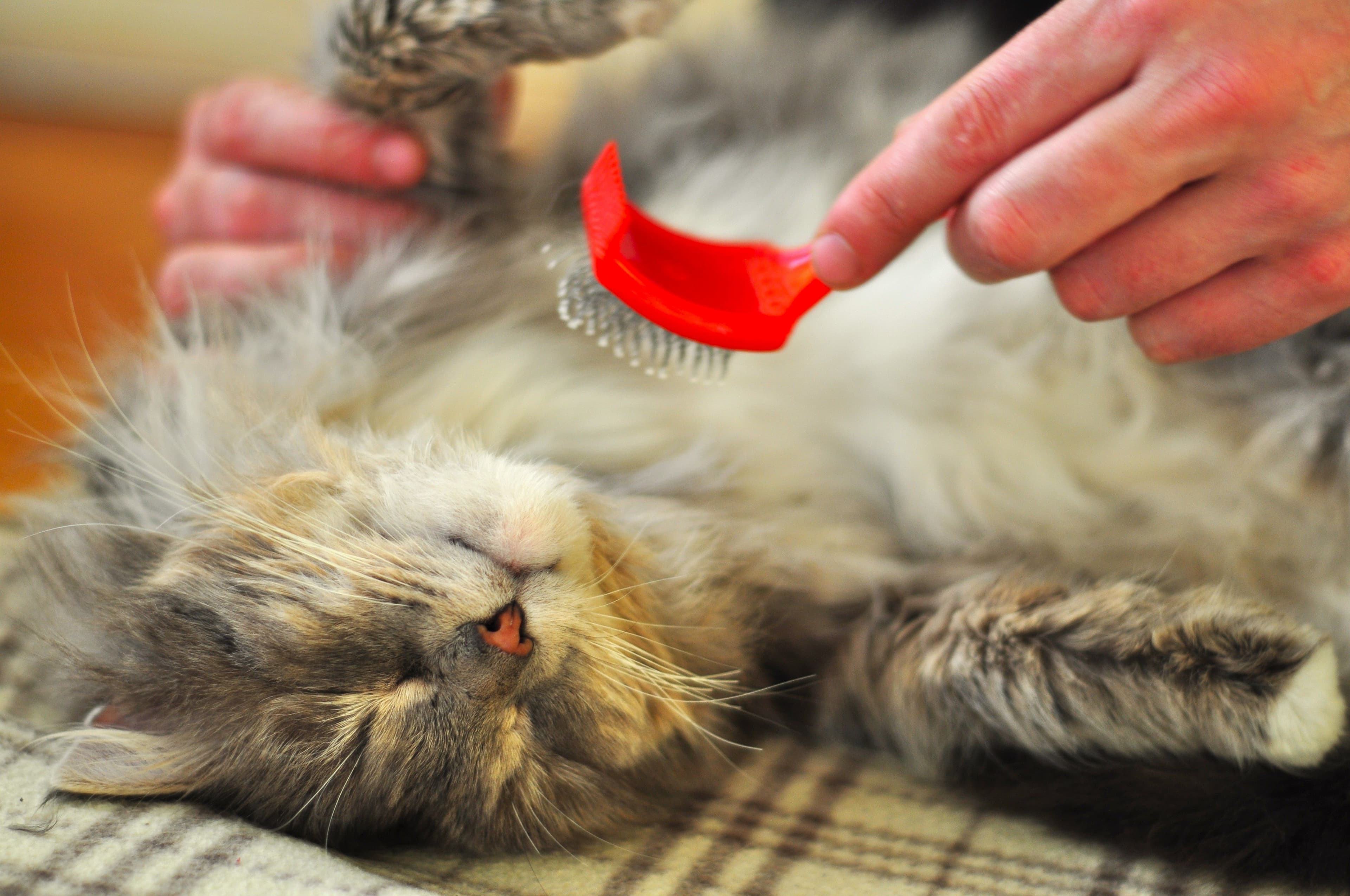
If diet manages hair after it's ingested, brushing prevents it from being ingested at all — which is why the long-hair-versus-short-hair gap in the survey data above isn't really about coat length, it's about how much hair ends up in a cat's mouth per grooming session. A cat that sheds into a brush loses that hair to the trash. A cat that sheds into its own tongue swallows it.
For long-haired cats specifically, veterinary dermatologists generally recommend daily brushing during heavy shedding seasons (spring and fall) and at least a few times a week the rest of the year — a frequency most owners intend to keep up and then don't, once shedding season passes. If you're managing more than one cat with different coat types and shedding calendars, that's a scheduling problem as much as a health one; ZooMinder's reminders work just as well for "brush the Maine Coon" as they do for medication, because the grooming habit that prevents hairballs only works if it's actually consistent.
OTC Cat Hairball Remedies: What Works, What to Skip
Petroleum-based lubricant gels and malt pastes are the most common OTC cat hairball remedies on shelves, and they do have a legitimate mechanism: they coat swallowed hair and help it slide through the GI tract instead of catching and clumping. Used occasionally — a few times a week, not daily — most veterinarians consider them low-risk for a cat that's otherwise healthy and simply an efficient groomer.
The caveats matter more than the marketing. Daily, long-term use of petroleum-based laxative pastes can interfere with absorption of fat-soluble vitamins (A, D, E, and K), which is why they're meant to be an occasional fix, not a daily supplement. Fiber-based OTC remedies — the cellulose or psyllium products built on the same research covered above — don't carry that same absorption risk and are generally the better long-term choice if hairballs are a recurring, low-grade issue rather than a rare event. For cats on a daily paste or fiber supplement, ZooMinder's medication reminders are the practical fix for the thing that actually derails these regimens: forgetting the dose two days in, which is exactly when the "occasional" product starts sliding toward "daily."
Here's the harder line: none of these products treat a true intestinal blockage, and using one on a cat that's actually obstructed just delays the vet visit that cat needs. Cornell's Feline Health Center describes the escalation path when home remedies aren't enough — a hairball that fails to pass can move from the stomach into the intestine and create a blockage that requires days of IV rehydration, prescription laxatives under monitoring, or surgery if it doesn't move. That's not a scenario a store-bought gel resolves; it's one it can mask.
When to Stop Trying Remedies and Call the Vet
The warning signs Cornell flags aren't subtle once you know them: a cat that's lethargic and refuses to eat for more than a day, or one that's retching repeatedly without producing anything, needs veterinary attention without delay — not another dose of hairball gel to see if it works. Add a hairball frequency that's climbing (once a month becoming once a week), diarrhea or constipation alongside the vomiting, or visible weight loss, and the picture shifts from grooming nuisance to something that needs bloodwork and possibly imaging to rule out a blockage, inflammatory bowel disease, or a food intolerance.
A hairball that doesn't come back up doesn't just disappear — it either passes on its own, or it becomes an obstruction that vets treat with IV fluids, monitored laxatives, and, in a meaningful share of cases, surgery.
This is exactly where a symptom history earns its keep. A vet meeting your cat for the first time — an emergency clinic on a Sunday, a new practice after a move — has to reconstruct a timeline from scratch unless you can hand them one. Logging hairball episodes, appetite changes, and litter box habits in ZooMinder means that timeline already exists, dated and specific, instead of "I think it's been worse the last couple weeks."
The Takeaway
Run the numbers from your own cat's year, not the pet-store aisle: if you're closer to one hairball a month than one a week, you're in the 73%-to-90% majority for whom this is genuinely background noise, and a brush plus a decent fiber diet are doing their job. The moment that ratio flips — weekly instead of monthly — the data says stop reaching for another tube of gel and start reaching for the phone.
Make This Easier With ZooMinder
You shouldn't need a spreadsheet to take care of your pet. ZooMinder is the free app that handles medication schedules, vet records, and reminders so you can focus on the cuddles.