Dog Dental Care at Home: What Your Vet Wishes You Knew
Elena was stopped at a red light on Avenida Mayor when Tofu, her eight-year-old dachshund, climbed into her lap and yawned directly into her face. The smell was so bad she checked the back seat for something dead. Three days later, brushing crumbs off the couch, she found a tooth — small, brown at the root, wedged into the cushion seam. Tofu had been eating normally the whole time.
That last detail is the one that traps almost everyone who goes looking for advice on dog dental care at home. Dogs are hardwired not to advertise oral pain. They chew on the other side, swallow food whole, and keep wagging. By the time an owner notices something, the problem is usually years old.
The number Elena's vet led with
"Roughly eighty percent of dogs show signs of periodontal disease by age three," her vet said, which tracks with what the AVMA and the American Veterinary Dental College have been repeating for years. Auburn University's College of Veterinary Medicine puts the figure at 70–80% by that same age. Tofu was eight.
Then came the part Elena hadn't understood in eight years of dog ownership. Plaque — the soft, invisible bacterial film — starts mineralizing into hard tartar within about 24 to 72 hours. Once it's tartar, no brush, chew, or rinse removes it. It has to be scaled off under anesthesia.
Everything you do at home is aimed at one narrow window: the day or two before plaque turns to cement. That's it. That's the whole game.
Which is why "I brush his teeth once a month, when I remember" is functionally the same as not brushing at all.
What the exam actually found
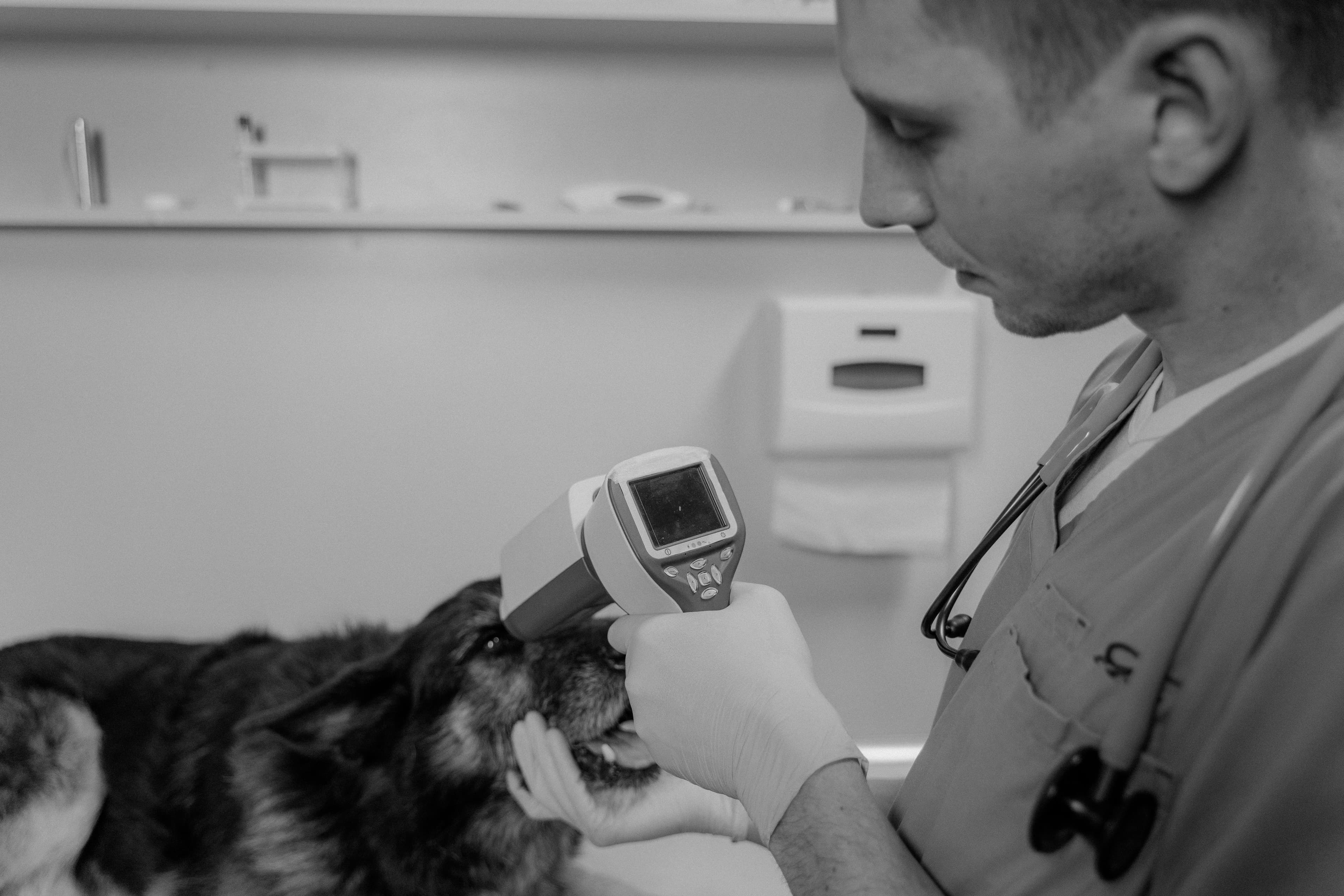
The visual exam was the smallest part of it. Tofu went under anesthesia, and the vet took full-mouth dental radiographs — because roughly 60% of every tooth sits below the gumline where no light and no fingertip can reach. Cornell's Riney Canine Health Center is blunt about this: the disease that matters is subgingival.
Tofu lost two teeth. One was already mobile. The other looked fine on the surface and was sitting on a root abscess.
Elena asked about the anesthesia-free cleanings advertised at a groomer near her. The answer was flat. The American Veterinary Dental College has formally opposed non-anesthetic dental scaling since 2004, and the 2019 AAHA Dental Care Guidelines for Dogs and Cats call it inappropriate outright — patient stress, risk of injury, aspiration risk with no protected airway, and zero diagnostic capability. Scraping visible tartar off the crown while leaving the bacteria under the gums is cosmetic. It makes the mouth look treated and leaves the disease exactly where it was.
Elena left with a clean-mouth baseline and one instruction: don't let it get here again.
Day one at home: sixty seconds, and no toothbrush
She made the mistake most people make — she came home, bought a toothbrush, and tried to pry Tofu's mouth open. He hid under the bed for two hours.
The approach that worked was slower and started with no brush at all:
- Days 1–3. Lift the lip on one side for three seconds. Treat. Done. Total time: under a minute.
- Days 4–7. Same, but run a fingertip along the outer surface of the upper canine and premolars. Treat.
- Week 2. Put a dot of dog toothpaste on your finger and let him lick it off, then repeat the finger-rub. Poultry-flavored enzymatic paste is a bribe, not a chore.
- Week 3. Introduce the brush, but only on the upper outer teeth, and only for as long as he tolerates it.
Two rules that are non-negotiable. Never use human toothpaste — many contain xylitol, which is severely toxic to dogs and can cause hypoglycemia, seizures, and liver failure, and the fluoride and foaming agents aren't meant to be swallowed. And don't chase the inside surfaces. The tongue does meaningful work there; the outer surfaces of the upper premolars and molars are where tartar builds, and they're the easiest to reach anyway.
Technique, once you're brushing: angle the bristles about 45 degrees toward the gumline, small circles, and prioritize the back upper teeth over the front ones. A soft child's toothbrush works. Finger brushes are gentler but give you less reach on the molars — fine for a starter, less good long term.
How often, honestly
Daily is the target, because of that 24-to-72-hour window. Most veterinary dentists will tell you that three or four times a week is the realistic floor where you still see measurable benefit — below that, you're mostly performing dental care rather than doing it.
Sixty seconds a day beats fifteen minutes on Sunday. It isn't close.
This is the least glamorous part of dog dental care at home and the part that quietly decides the outcome. Elena set a nightly reminder in ZooMinder tied to Tofu's after-dinner walk — the streak is the point, not the perfection of any single session. Habits that ride on top of an existing routine survive; standalone ones don't.
The chews-and-water-additive aisle, decoded
Elena's next question was the obvious one: can't a chew do this for me?
Partly. Here's the honest hierarchy.
Look for the VOHC seal. The Veterinary Oral Health Council awards its seal to products that demonstrate at least a 20% reduction in plaque or tartar in controlled trials. That's a real, verified standard — and it's also a modest one. A VOHC-accepted chew is a legitimate supplement to brushing. It is not a replacement for it.
Dental chews and dental diets work mechanically, by forcing the tooth through an abrasive matrix. They only clean where the tooth actually contacts the chew, which is mostly the crown tips — not the gumline, where disease starts. Watch the calories, too: a daily large-breed dental chew can run 80–100 kcal.
Water additives are the weakest tool of the three, but also the easiest to sustain, which counts for something in a household that will never brush. Two cautions: some additives are palatable enough that a dog drinks less water, and you must read the label for xylitol. Also skip the additive if your dog has kidney disease or is on a restricted diet without asking your vet first.
What to avoid entirely: antlers, bones, hooves, ice cubes, and rock-hard nylon chews. These fracture the upper fourth premolar — the big carnassial tooth — and slab fractures there are one of the most common reasons a dog ends up in surgery. The rule of thumb from veterinary dentists: if you can't dent it with your thumbnail, or you'd wince if it hit your knee, it's too hard for your dog's teeth.
The signs Elena watches for now
Bad breath was the only one she'd noticed, and she'd written it off as "dog breath" for years. Persistent foul breath is not normal. It's bacteria. The rest of the list, in rough order of how often it gets missed:
- Chewing consistently on one side, or dropping kibble
- Blood streaked on a chew toy or in the water bowl
- Brownish-gold buildup along the gumline, especially the upper back teeth
- Red, puffy, or receding gums
- Pawing at the mouth, head shaking, or jaw chattering
- A sudden preference for soft food, or slowing down at meals
- Swelling below one eye — a classic sign of a carnassial root abscess
- Reluctance to play tug, or flinching when you touch one side of the face
Elena photographs Tofu's gumline once a month and keeps the photos in his ZooMinder symptom log, dated. Month to month you notice nothing. Compared against a photo from last spring, a receding gumline is obvious. She also keeps his dental chart, the radiograph report, and the date of his next cleaning in his records there, which mattered more than she expected the first time she saw a different vet at the clinic and could pull up exactly which two teeth were already gone.
What actually changed
Tofu's routine now takes about ninety seconds. Brush after dinner, a VOHC chew three times a week, a professional cleaning scheduled on a cycle his vet sets based on how his mouth looks — not on a generic calendar, because dachshunds and other small breeds have crowded teeth and typically need cleanings more often than a Labrador does.
Nine months in, at his recheck, the vet said the words Elena had been hoping for: nothing new.
She still thinks about the tooth in the couch cushion. Not because of the extraction, or the bill, but because of the three years Tofu spent chewing on one side while she watched him eat his dinner every night and concluded he was fine. A dog who is eating is not a dog who is comfortable. That was the whole lesson, and it cost him two teeth to teach it.
Keep Your Pet's Health on Track with ZooMinder
ZooMinder helps you manage medication schedules, track vet appointments, and keep complete health records for all your pets — all in one free app.