Dog Limping: When to Worry (And When the Rest Rule Fails)
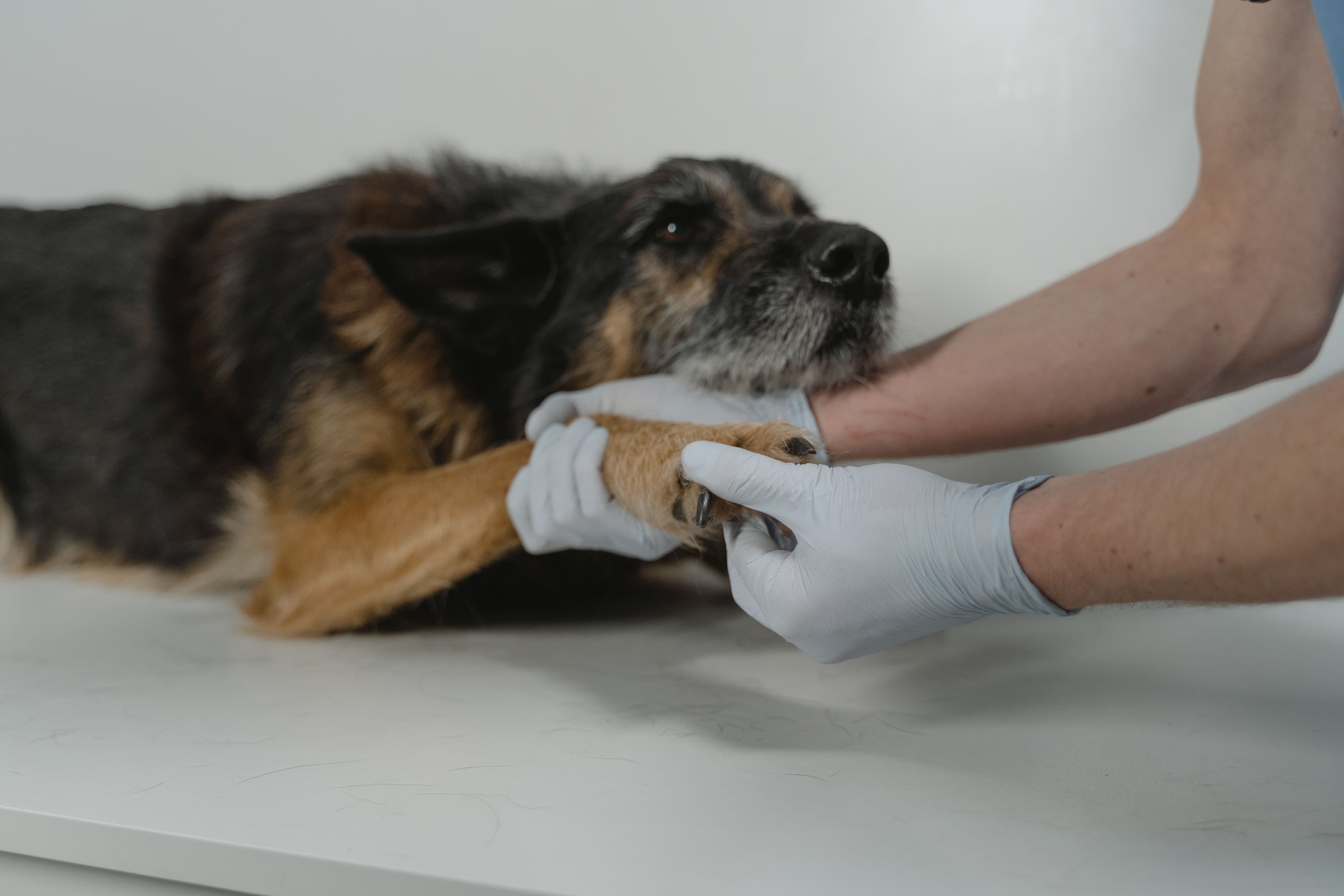
A seven-year-old Labrador named Otis jumped off the couch on a Tuesday, yelped once, and held up his right hind leg. By Thursday he was putting weight on it again, so his owner cancelled the vet appointment. If you search dog limping when to worry, you'll find the advice that made that decision feel completely reasonable: rest for 24 to 48 hours, and if it hasn't improved, call your vet.
That advice isn't wrong. It's just incomplete in a way that matters, because a partially torn cranial cruciate ligament also improves in 48 hours — and then finishes tearing three weeks later on a normal walk around the block. Otis went in five weeks after the couch. The surgery was the same surgery it would have been in week one. What had changed was the meniscus.
The 48-hour rule is a good test, not a treatment
The rule exists for solid reasons. Most limps really are soft-tissue strains, overuse from a weekend that was more athletic than usual, or a paw pad that met something sharp. Vets don't want you in an emergency room at 2 a.m. for a bruised toe, and dogs heal a lot of minor things on their own.
But notice what the rule actually is: a diagnostic test. You're removing the load and seeing what the leg does without it. And most people run it wrong in two ways.
First, "rest" gets interpreted as "a shorter walk." Real rest means leash-only trips outside for bathroom breaks, no stairs, no jumping on or off furniture, no fetch, no dog park, no wrestling with the other dog. If you run the test at 60% strictness, the result tells you nothing.
Second — and this is the bigger one — improvement during rest doesn't rule anything out. It only rules out "so severe it couldn't possibly improve in two days." Partial cruciate tears improve with rest. Early bone tumors improve with rest. Elbow dysplasia improves with rest. Improvement is not a diagnosis; it's a data point.
The limps you skip the test on entirely
Before you decide whether to rest and watch, run through the list of things that don't get watched. Go to an emergency vet now if your dog:
- Won't bear any weight at all, even standing still, especially after a fall, a jump, or an impact. Complete non-weight-bearing lameness suggests fracture, dislocation, or a full ligament rupture.
- Has a visibly deformed, dangling, or crooked limb, or an open wound over a joint or bone.
- Is dragging a paw, knuckling over, or wobbling in the back end. That's a neurological sign, not an orthopedic one — intervertebral disc disease has a treatment window measured in hours, not days.
- Has a hot, swollen joint alongside fever and lethargy.
- Was hit by a car, even if the limp looks minor. Internal injuries don't limp.
- Is panting, trembling, unable to settle, or crying when touched. Pain out of proportion to what you can see is its own red flag.
Add one more that gets missed constantly: limping in more than one leg, shifting from day to day, with a fever. A rectal temperature of 39.4–40.6 °C (103–105 °F) with shifting-leg lameness and swollen joints is the classic presentation of tick-borne disease and immune-mediated polyarthritis, per the Merck Veterinary Manual. That dog needs bloodwork today, not crate rest.
How dramatic the limp looks tells you almost nothing about how serious it is
This is the intuition that fails most often. A dog with a torn toenail will hop on three legs, scream, and leave blood on the floor. It's a ten-minute fix. Meanwhile, osteosarcoma — the most common canine bone cancer — typically shows up as a mild, intermittent limp. Davies Veterinary Specialists notes that this lameness often responds to painkillers at first, but rarely for more than a week or so. It's usually a large or giant breed, most often diagnosed around six to eight years old.
Cranial cruciate ligament disease follows the same pattern in reverse of what owners expect. It's the most common orthopedic condition in dogs and the most common stifle problem requiring veterinary care, with prevalence estimates commonly cited in the 3–5% range. Witsberger and colleagues, reviewing North American veterinary hospital records in JAVMA, found prevalence peaked in dogs seven to ten years old, and that dogs over 22 kg were hit harder and younger. Plenty of those dogs walk into the exam room bearing weight on a knee that is already partly torn.
Limp severity tracks how much something hurts right now. It doesn't track how much the underlying problem will cost you in six months.
"It went away" is the most misread sentence in a lameness history
Owners open with it as reassurance. Vets hear it as a finding. Intermittent lameness is a pattern, and patterns are diagnostic. Roughly:
- Stiff after rest, loosens up after ten minutes of movement → classic osteoarthritis. This is the one case where strict rest can actively make things worse; these dogs need controlled, consistent, low-impact activity, not a crate.
- Fine at rest, worse after exercise — especially the next morning → partial cruciate tear, hip or elbow dysplasia.
- Switches legs between episodes → think systemic: tick-borne disease, immune-mediated joint disease.
- Same leg, same spot, gradually worsening over weeks in a big older dog → get imaging. Don't wait this one out.
- Toy breed skips a step, shakes the leg, carries on normally → often a luxating patella, worth grading before it becomes arthritis.
- Large-breed puppy, shifting lameness, self-resolving → possibly panosteitis, but that's a diagnosis of exclusion, not a guess you make at home.
One more trap: finding a cause doesn't mean you found the cause. You pull a foxtail out of the webbing, and the dog still limps two days later. The foxtail was real. It also wasn't the whole story.
Dog limping: when to worry is a question of pattern, not a countdown
Here's the triage that actually works, in order:
1. Can they put any weight on it? No weight at all, or a deformed limb, or neurological signs → emergency, today.
2. Is anything systemic going on? Fever, off their food, lethargic, more than one leg affected, a swollen joint → same-day vet visit, not rest.
3. Neither? Then you've earned the rest test — run strictly, 48 hours, no shortcuts.
And then override the rest test and book an appointment anyway if any of these are true: the limp has been coming and going for more than two weeks, your dog is over seven and over 20 kg, this is the third episode this year, or it got better and came back. That last one is not a sign of healing. It's a sign of something that intermittently exceeds a threshold.
What to write down before you go — this changes the diagnosis, not just the paperwork
Lameness workups live and die on history, because the limp frequently vanishes in the exam room the moment adrenaline kicks in. What you bring matters:
- Which leg, exactly. Front or back, left or right from the dog's perspective. Owners get this wrong constantly. Better: shoot ten seconds of video of your dog walking away from you and toward you on a hard, flat surface. Watch for the head bob — dogs lift their head when the sore front leg hits the ground.
- The date and time you first noticed it, and what they were doing in the hour before.
- The grade: no weight at all / toe-touching / obvious limp / only visible at a trot.
- Better or worse after rest? After exercise? First thing in the morning?
- Did they yelp? Once, or repeatedly?
- Every previous episode with dates, even the ones that resolved in a day.
- All medications and supplements, doses, and when you last gave them — including anything over the counter.
- Current weight, and any change in the last six months. Weight is the single biggest modifiable factor in joint disease.
- Tick exposure, travel history, and the date of the last tick preventive.
This is exactly the kind of thing ZooMinder's symptom log is built for — timestamped entries with photos or video attached, so "it started sometime last month, I think?" becomes "first episode June 3rd after the beach, second June 19th, third July 2nd, all right hind." Three dated entries turn a shrug into a pattern. The weight tracking is worth turning on for the same reason: a chart showing 4 kg of creep since January is a conversation your vet can actually act on.
Two things not to do while you wait
Don't reach for your own medicine cabinet. Ibuprofen and naproxen cause gastric ulceration and kidney failure in dogs, and acetaminophen causes liver damage and impairs oxygen transport in the blood, per VCA Animal Hospitals. A single 200 mg ibuprofen tablet can poison a small dog. There is no safe human painkiller for a limping dog.
Don't stop a prescribed anti-inflammatory early because the limp resolved. If your vet sends you home with a course of an NSAID, finishing it matters — and so does noting exactly when the limp returns afterward, because "he was perfect on the medication and limped again four days after it ran out" is genuinely useful clinical information. Set the reminders somewhere that logs when you actually gave each dose; ZooMinder's medication tracking keeps that record without you having to reconstruct it from memory at the recheck.
Here's the actual rule
Rest and watch for 48 hours isn't bad advice. It's a good default that's been asked to carry more weight than it can. The complete version has three conditions attached: rest only after you've cleared the emergency list, only if you can enforce it strictly, and only if you treat the outcome as information rather than a verdict.
Otis's owner did everything the internet told her to do. The leg improved on schedule, exactly like a mild strain would. The only thing the 48-hour rule couldn't tell her was that the improvement was real and the injury was too — both at once. A limp that goes away is still a limp. Write down the date, and watch for the second one.
One App, Every Pet, Zero Missed Doses
Stop juggling sticky notes and phone alarms. ZooMinder keeps every medication, vaccine date, and vet note in one place — free, private, and built for households with multiple pets.