How to Give Liquid Medication to a Dog Without a Fight
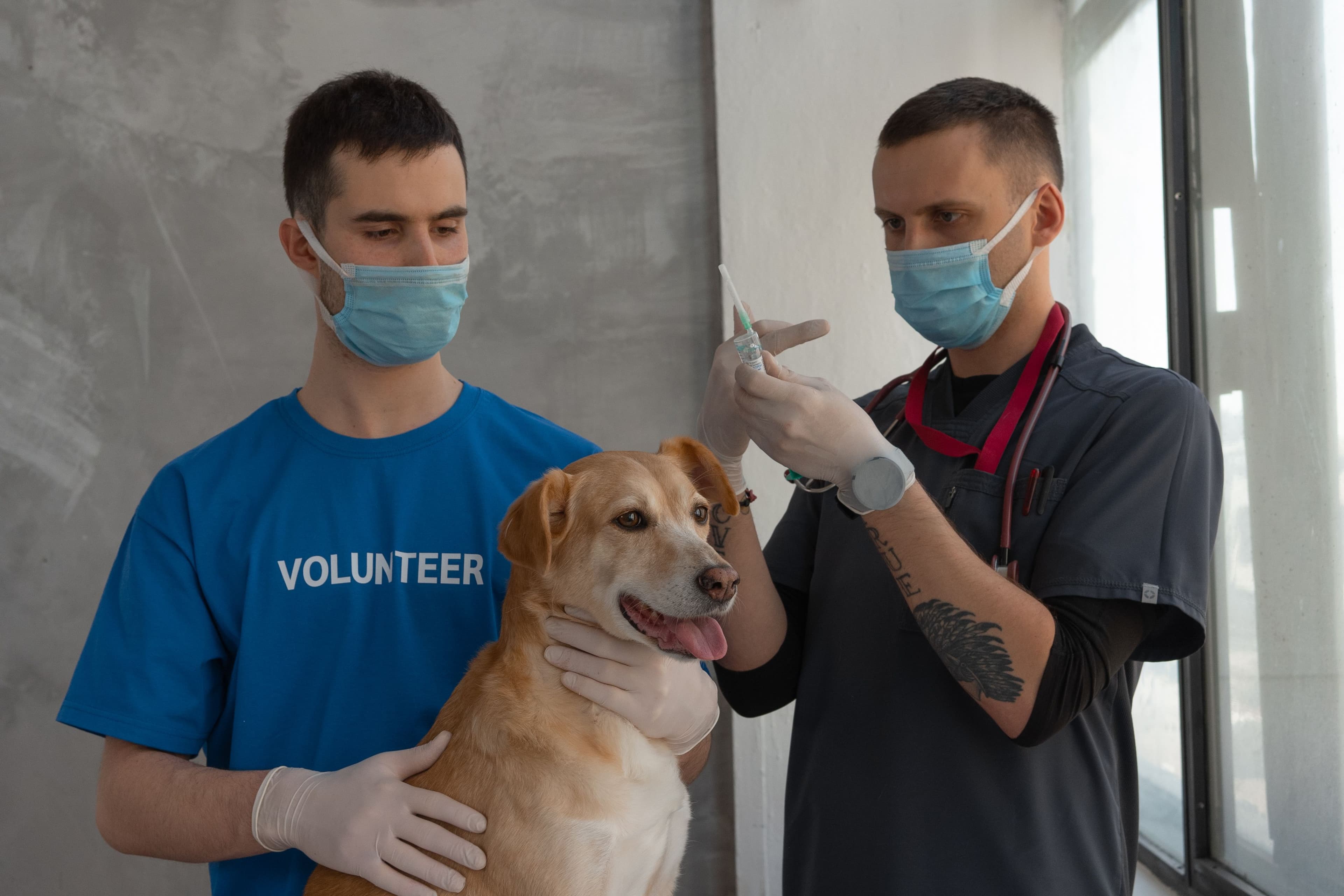
The 3 mL of metronidazole your dog just sprayed across the kitchen floor is probably not the whole dose. It looks like the whole dose — that's what foamy drool is for — but by the time a dog reacts to a bitter liquid, most of it has already crossed the back of the tongue. Nearly every guide on how to give liquid medication to a dog ends the same way: if your dog spits it out, don't re-dose, call your vet. That's the correct instruction paired with the worst possible explanation, because it leaves you standing in the kitchen convinced the dose is on the floor when it usually isn't.
The conventional advice is not wrong. Syringe into the cheek pouch, go slow, reward afterward — that's what a good vet tech does, and it works on most dogs most days. What the advice skips is the handful of situations where following it literally makes things worse: the flat-faced dog, the drug that binds to your dog's dinner, the drug that needs dinner to avoid vomiting, and the dog who learned three days ago exactly what the syringe means. Those aren't edge cases. In a 2024 study of dog owners in New Zealand, medication noncompliance was recorded for 47% of owners, and 76% of the noncompliant owners said the reason was simply that their dog resisted.
The cheek pouch is right. The head tilt that comes bundled with it is wrong.
Watch enough owners and you'll see the same move: syringe in the cheek, and simultaneously the other hand pushes the muzzle up toward the ceiling, the way you'd tip a bottle into a baby. It feels like it should help gravity do the work.
A dog swallows worst in exactly that position. Extending the neck straightens the path from mouth to airway and makes a coordinated swallow harder, which is why improper administration of liquid medicines is a recognized cause of aspiration pneumonia in dogs. The medication does go down faster. Some of it just goes down the wrong tube.
What to do instead:
- Keep the nose roughly parallel to the floor, or tilted up no more than about 15 degrees. Your dog needs to be able to swallow, not to be a funnel.
- Slide the syringe tip into the side of the mouth, behind the canine tooth, in the gap between the canine and the premolars. You do not need to open the jaw.
- Aim the tip at the tongue, angled slightly toward the opposite cheek — not straight down the throat. VCA Animal Hospitals is explicit about this: depositing liquid directly at the back of the throat is what invites inhalation.
- Deliver in small pushes with a pause between each, not one continuous squeeze. Half a millilitre, pause, half a millilitre. Watch for the swallow before the next push.
- Split anything over about 1 mL in a small dog into two administrations a minute apart.
For brachycephalic dogs — pugs, French bulldogs, shih tzus, boxers — this matters more, not less. These breeds already coordinate breathing and swallowing poorly, and they're overrepresented in aspiration pneumonia cases. Shorter muzzle means less room for error, so go slower and use smaller volumes than you think you need. If your flat-faced dog reliably chokes or gags on liquids, that is a legitimate reason to ask your vet whether the same drug exists as a tablet.
Most of what your dog "spat out" was already down
Here is the part that saves people from real trouble. Bitter drugs — metronidazole is the classic offender, along with a lot of compounded antibiotics — trigger immediate hypersalivation. Saliva mixes with the residue on the tongue and produces a volume of foam that can easily be five or ten times the volume of the actual dose.
A dog who drools after a dose has tasted the medication. A dog who tastes the medication has, by definition, had it in their mouth.
Drooling that stops within a few minutes, in a dog who is otherwise behaving normally, is a taste reaction, not a medical event. What deserves a call is drooling that persists for hours, or comes with vomiting, weakness, or trouble swallowing.
Do not re-dose on your own judgment. With most short-course antibiotics a partial dose is a minor problem; with a cardiac drug, a seizure medication, or an NSAID, a double dose is a much bigger one. Note what happened and ask your vet's office at the next reasonable opportunity.
This is where writing it down stops being bureaucratic. If you tell your vet "he's been on it a week and he's not better," that's one conversation. If you can say "day 2 evening dose he foamed and I estimate half went in, day 4 he vomited twenty minutes after, the rest were clean" — that's a different conversation, and it changes what the vet does next. Logging each dose as given, partial, or missed is exactly what ZooMinder's medication tracking is for, and it's the log you want in your hand at the recheck rather than reconstructed from memory in the exam room.
"Never mix medication with food" is wrong about half the time
Somewhere along the way this hardened into a rule, and it shouldn't have. Plenty of drugs are better with food. Amoxicillin-clavulanate (Clavamox) can be given with or without, but giving it with a meal reduces the stomach upset it commonly causes — and if a dog vomited after a dose on an empty stomach, the standard advice is to try the next one with food. Doxycycline and most NSAIDs are similar stories.
The actual problem with food isn't food. It's measurement.
Squirt 4 mL into a full bowl and you have converted a measured dose into an unmeasured one. If your dog leaves a fifth of the bowl — a normal thing for a sick dog to do — you don't know whether they got 80% of the dose or 40%, because the medication doesn't distribute evenly. Add a second dog in the house and now you don't know who got it. This is the mechanism behind one of the more sobering compliance findings: reviewing owners on short-term antimicrobials, 56% to 59% administered the incorrect number of doses per day, most of them underdosing (Clinician's Brief, Improving Owner Compliance with Pet Medication Regimens).
The fix takes ten seconds. Mix the dose into about a tablespoon of something intensely good — wet food, plain canned pumpkin, a spoon of pâté — and give that small portion first, watched, before the rest of the meal. Small enough to finish in one gulp, appealing enough to be finished, and you can see it happen. Then feed dinner. In multi-pet households, feed the medicated dog separately until the course is done; ZooMinder's per-pet medication schedules are worth setting up here purely so you never have the "wait, did Luna get hers or was that Cooper?" moment at 10pm.
The foods that quietly cancel the dose
Some combinations don't reduce compliance — they reduce the drug.
Dairy and calcium with tetracyclines. Doxycycline and its relatives bind, or chelate, to calcium. Once bound, the antibiotic can't be absorbed in the intestine; it passes through your dog largely unused. Cheese is the classic mistake because it's also the most popular pill-hiding food on earth. Aluminum and magnesium do the same thing, which means antacids, calcium supplements, and some joint supplements count too. If you can't avoid it, separate them by 1 to 2 hours in either direction.
Hot food. Never microwave medication. If a refrigerated suspension is uncomfortably cold, hold the filled syringe in your hand for a minute or two, or float it in warm water. Heat can degrade the drug.
The water bowl. Diluting medication into drinking water is guessing, not dosing — and a sick dog's water intake is the last thing you want to make unappealing.
Peanut butter with xylitol. Xylitol (sometimes labeled birch sugar) is severely toxic to dogs and now appears in a number of "natural" and reduced-sugar peanut butters. Read the label of the specific jar you own, every time you buy a new one.
How to give liquid medication to a dog who has already decided against it
By day three, a lot of dogs stop cooperating — not because of the taste, but because the syringe has become a reliable predictor of an unpleasant event. You didn't just medicate your dog; you accidentally trained a warning signal. Cornell's Riney Canine Health Center makes the point that the goal is to keep the whole interaction from becoming something the dog dreads.
Reversing it is straightforward, and takes about two days of low effort:
- Load an identical syringe with low-sodium chicken broth or the liquid off a can of tuna. Between doses, several times a day, let your dog lick it out of the syringe tip. No restraint, no holding. The syringe now predicts broth more often than it predicts medicine.
- Change your body position. Kneel or sit beside your dog, facing the same direction, one arm loosely along their chest. Looming over the front of a dog is confrontational body language, and it's what most owners default to.
- Change the room. If the kitchen has become the medicine room, dose somewhere else.
- Let them lick it off the syringe tip if they'll take it that way. Slowly depressing the plunger while a dog voluntarily licks is the lowest-stress method that exists, and for palatable flavored suspensions plenty of dogs accept it.
- Reward immediately after — every single time, including the doses that go badly. Especially those.
The move most owners make on day nine instead of day two
If a drug is genuinely foul and your dog is genuinely resistant, better technique has a ceiling. Call the practice and ask a different question.
The right question after a terrible dose isn't "how do I hold him better?" It's "does this drug have to be a liquid, and does it have to taste like this?"
Often the answer is no. Many drugs exist as tablets, chews, or capsules that can go inside a pill-hiding treat. Compounding pharmacies can reflavor bitter suspensions into chicken, beef, or fish — and the industry has been moving this way generally; Virbac's flavored metronidazole oral suspension was the first such product to earn both EMA and FDA approval specifically because palatability drives whether the course actually gets finished. Sometimes the dose can be consolidated from three times daily to twice. Any of these beats nine more days of wrestling.
There's decent evidence that structure helps as much as chemistry. In a small 2020 study in Pharmacy of 30 dogs being treated for atopic dermatitis, owners using a medication-reminder app showed non-adherence of just 12.6% — against a background where roughly half of owners miss doses. Thirty dogs is thirty dogs, not proof. But the mechanism is unglamorous and believable: a reminder at the right hour, and a record of what actually happened.
Here's the actual rule
Cheek pouch, yes — but nose level, tip aimed at the tongue, delivered in small pushes with a pause to swallow. Food, yes — but a measured tablespoon of it before the meal, never stirred into a full bowl, and never with dairy if your dog is on doxycycline. And when the drool comes, assume the dose went in, write down that it was messy, and don't repeat it.
The foam on your kitchen floor is mostly saliva and mostly theater. The dose that's actually missing is the one you skipped on Thursday because the whole thing had become a fight nobody wanted — and that one, unlike the theatrical one, is fixable with a phone call to the pharmacy.
Never Forget a Dose Again
ZooMinder turns the tips in this article into automatic reminders. Add your pet, add their meds, and let the app handle the rest — across as many pets as your household needs.