Signs Your Pet Is in Pain: The Quiet Clues Dogs and Cats Hide
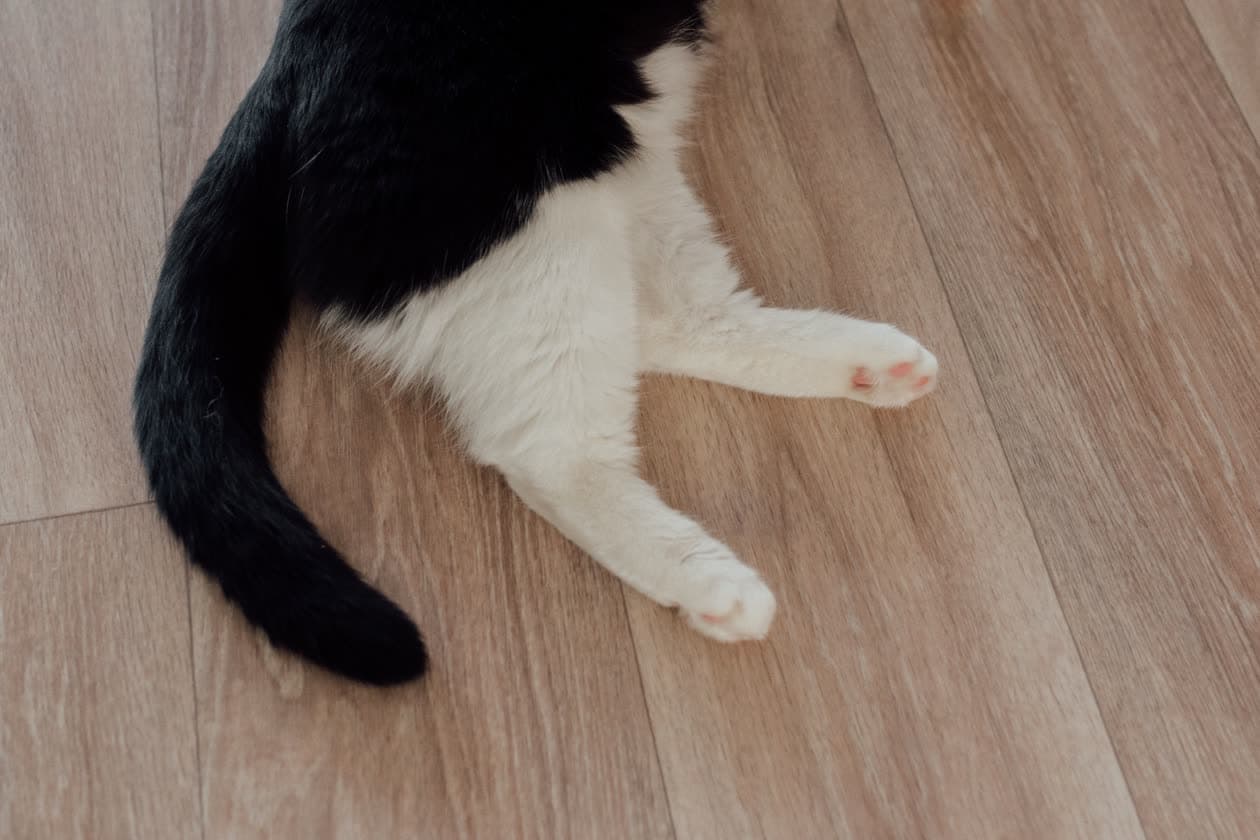
For six years, Miso's spot was the top of the refrigerator. Lucía's 11-year-old tabby went up every evening by the same route: chair, counter, fridge. She was as predictable as the dishwasher. Then, sometime in October, Lucía noticed the fridge was empty and Miso was sleeping on the kitchen mat. That was the whole sign. Miso didn't limp, didn't cry and kept eating, so it would have been easy to decide she had simply mellowed with age.
Lucía and Miso are an invented example, but this pattern comes up again and again in veterinary pain research. The most reliable signs your pet is in pain are usually not sounds. They are changes: a jump that stops happening, grooming that gets sloppy, a dog who pants on a cool evening, a cat who squints at nothing. Pain in dogs and cats tends to show up as a missing habit, not a dramatic symptom.
The week the fridge went empty
When Lucía looked back, the fridge wasn't the only thing that had changed. Miso's coat had gone slightly spiky along her lower back and hips. Once Lucía started paying attention, she noticed a few more things:
- Miso had stopped using the windowsill, which needs a standing jump.
- Twice she had peed just outside the litter box, as if the edge had become a hurdle.
- She flinched and flicked her tail when stroked over the hips. That used to be her favorite spot.
- She slept more and showed up less for the evening game with the feather wand.
Each of these on its own has an innocent explanation. Together they're a recognizable picture. In a 2016 study published in PLOS One, researchers Isabella Merola and Daniel Mills asked an international panel of feline experts to agree on behavioral signs of pain in cats. The panel identified 25 signs that are each enough to suggest pain, but none that is required. The list included hiding, a hunched posture, reduced grooming, less jumping, changes in appetite, and reacting when a body area is touched. In other words, a cat in pain doesn't have to tick every box. It only needs to show one or two in a cat who used to be different.
Arthritis is the classic hidden culprit in older cats. In a 2010 study in Veterinary Surgery, Duncan Lascelles and colleagues X-rayed 100 cats across a range of ages and found signs of degenerative joint disease in roughly nine out of ten. An X-ray finding doesn't prove every one of those joints hurts. Still, it explains why "she's just getting old" so often turns out to mean "she's getting stiff."
Dental pain is the other common one. Watch for a cat who drops food, chews on one side, or walks up to the bowl with interest and then walks away.
Why the loudest pet in the house isn't the one hurting
Lucía also has Toby, a four-year-old beagle who howls as if betrayed when someone brushes his tail with a foot, then trots off ten seconds later to steal a sock. Toby helps explain the problem: we learn what pain looks like from the pets who complain, and then miss the ones who don't.
Cats are especially good at staying quiet. The common explanation is evolutionary: a small animal that is both predator and prey gains nothing by advertising weakness. Whatever the reason, cats often look most "normal" in exactly the places where you'd want them to look sick, like the clinic exam table or a room full of strangers.
Dogs show more, but they also hide plenty, especially chronic pain from arthritis, back problems, or sore teeth. Common canine tells include:
- Panting or restlessness at rest, especially at night or in a cool room
- Hesitating before stairs, the car, or the sofa, or needing a "run-up" for something that used to be easy
- Stiffness after lying down that eases once they get moving
- Shifting weight off one leg, or sitting with a hind leg kicked out to the side
- Licking or chewing one spot, often a joint
- Grumpiness when picked up or touched, or avoiding being handled
- Shorter walks: lagging behind, sitting down mid-walk, turning for home early
- Tail carried lower, ears held back, a "worried" face
The difference matters in practice. With dogs, look for pain in their movement. With cats, look for it in their schedule and their face.
The face Lucía couldn't unsee
This is the part that surprised Lucía, and it may surprise you. Some of the best tools for reading animal pain began with lab mice.
In 2010, a team led by Dale Langford and Jeffrey Mogil at McGill University published the Mouse Grimace Scale in Nature Methods. They borrowed an idea from human medicine, where pain is assessed by coding facial expressions in people who can't describe it, such as newborns. They then showed that mice in pain make a consistent face: narrowed eyes, bulging nose and cheeks, ears pulled back, whiskers changed. Grimace scales have since been developed for many species.
For cats, the version is the Feline Grimace Scale, validated in a 2019 Scientific Reports study by researchers at the Université de Montréal. It scores five features:
- Ears: rotated outward and flattened, instead of upright and forward
- Eyes: squinted or narrowed (orbital tightening)
- Muzzle: tense and more elliptical, instead of relaxed and round
- Whiskers: straighter and pulled forward, instead of loose and curved
- Head position: held lower than the shoulders or tucked down
The part that matters most for owners: a 2021 follow-up in the same journal had cat owners, veterinarians, vet students and nurses score the same 100 images. The owners' scores agreed very closely with the veterinarians' scores. This isn't a diagnosis kit, and the scale was validated for acute pain rather than slow, chronic pain like arthritis. But you can learn to see that face, and with a bit of practice you can see it reliably.
When Lucía looked at Miso loafing on the mat, with paws tucked, head slightly low and eyes half shut, she could finally see it too.
A content cat squints at you slowly. A cat in pain squints at nothing in particular. Once you know the difference, you can't unsee it.
What she wrote down before the appointment
Lucía booked a vet visit and did the most useful thing an owner can do beforehand: she collected evidence from home, because Miso was almost certainly going to act fine on the exam table.
The 2022 AAHA Pain Management Guidelines for Dogs and Cats stress that owner observation is especially important for chronic pain. Your vet sees 20 minutes of your pet. You see the other 23 hours and 40 minutes. A useful log covers:
- What changed, and roughly when. "Stopped jumping on the fridge around early October" is more useful than "seems off."
- How often. Was it one missed jump, or every day for two weeks?
- Short videos. Film your cat trying the jump, stepping into the litter box, or walking across the room. Film your dog getting up after a nap, or on the stairs. Video is often the best evidence you can bring.
- Appetite, water, litter box or toilet habits, including any accidents outside the box.
- Anything you've given. That includes supplements and especially any human medication. (More on that below.)
- What helps or makes it worse. Cold mornings, long walks, after play.
Bring it all on your phone. A list of five dated observations will tell your vet more than "she's been a bit quiet."
When the signs your pet is in pain can't wait until Monday
Most subtle signs call for a vet appointment soon, not a midnight drive. Some don't. Contact a vet or emergency clinic right away if you see:
- Straining in the litter box or to pee with little or no urine coming out, especially in a male cat. A urinary blockage can become life-threatening within hours.
- A dog retching without bringing anything up, especially with a swollen belly. This can be gastric dilatation-volvulus (bloat), which is most common in large, deep-chested breeds and is a true emergency.
- Labored breathing, or open-mouth breathing in a cat
- Sudden inability to use the hind legs, especially in a cat who is crying out
- Pale, gray or bluish gums, collapse, or extreme weakness
- Crying out when touched, being unable to settle or lie down, or a hard, tense belly
- Any significant trauma, such as a fall or a car accident, even if your pet seems fine afterward
- Any human painkiller swallowed, whether by accident or given "to help"
That last point needs saying plainly: don't give your pet human pain relievers. Acetaminophen (paracetamol) is especially dangerous for cats, and ibuprofen can cause stomach ulcers and kidney damage in dogs and cats. Safe pain relief for pets is species-specific and dosed for the individual animal. That's your veterinarian's call, not the medicine cabinet's.
If you're unsure whether something is an emergency, call. Clinics triage over the phone all the time, and no one will think less of you for asking.
What the vet found, and what came after
In our example, the exam and X-rays pointed to arthritis in Miso's hips. That's a common story with plenty of options. Depending on the cat, those can include prescription pain management, weight control, and some low-tech changes at home: a step stool by the counter, a litter box with one low side, a heated bed somewhere that doesn't require a jump.
The vet also asked Lucía to come back for a recheck to see whether the plan was working. Pain management depends on that follow-up, because "is she better?" is a question you answer with observations, not a guess. Lucía put the recheck date in ZooMinder alongside Miso's prescription. That way the dose history showed exactly which doses were given or missed, and at the recheck she could tell whether a good week matched consistent dosing or just a warm spell. That's a small, practical use of a medication log. It doesn't tell you what's wrong, but it gives your vet better information.
She kept the same notes she'd started before the first visit: Windowsill? Grooming? Litter box? Fridge?
Back on the fridge
About a month in, Lucía came home to find Miso on the counter, eyeing the fridge, and making the jump on her second try.
Here's the one thing worth doing today. Write down three things your pet does every single day without fail: a jump, a greeting, a sleeping spot, a toy, a walk route. That's your pet's baseline. Pain rarely shows up as something new. It shows up as one of those three things quietly disappearing, and if you've written them down, you'll notice.
Keep Your Pet's Health on Track with ZooMinder
ZooMinder helps you manage medication schedules, track vet appointments, and keep complete health records for all your pets — all in one free app.